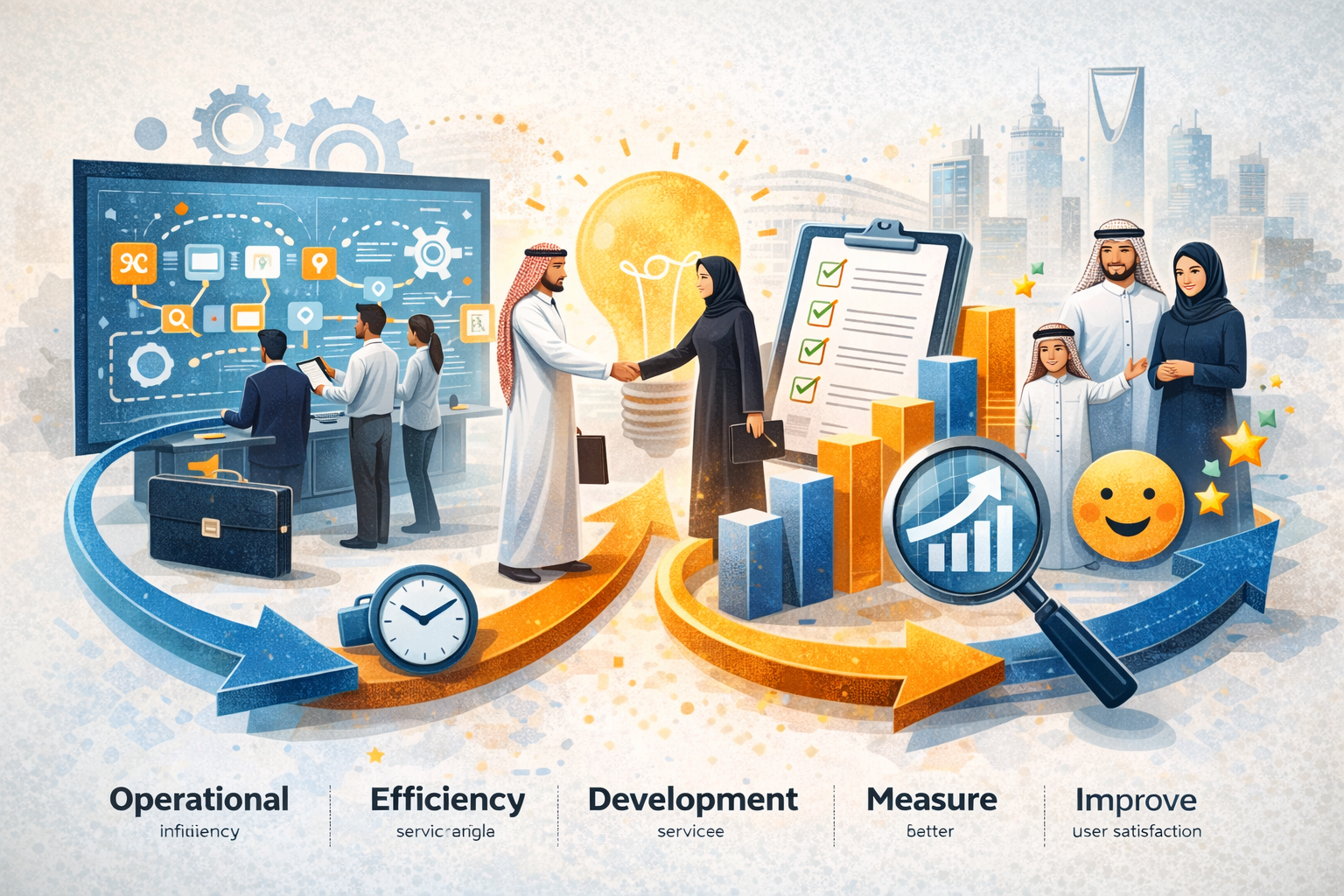

360-degree evaluation is one of the most effective tools available for raising staff performance inside Saudi organisations, particularly as all-round performance review and advanced analysis become more widely used. It gives a deep view of professional behaviour from several sources at once, which makes it fundamental for any company aiming to build a high-performing, dependable working environment.
How 360-degree evaluation strengthens all-round performance review
Understanding how an organisation really sees its people
The value of all-round performance review shows up as soon as 360-degree evaluation is in place. It does not rest on the line manager’s view alone: it gathers input from colleagues, direct reports, and internal and external customers, which gives an accurate picture of how someone performs and how they behave professionally.
What this looks like in practice
Take a logistics operation running several depots. Bringing operations teams into each other’s evaluations tends to surface coordination problems that no single manager sees from their own position — handovers that keep slipping, instructions that are read differently in two places — and those are the problems that quietly generate operational errors.
In short
Combining 360-degree evaluation with all-round performance review gives Saudi organisations a more accurate basis for HR development decisions, reduces individual bias, and makes evaluation fairer.
What peer feedback does for a working culture
Why colleagues’ views matter so much
Peer feedback is the turning point in 360-degree evaluation, because it reveals things a manager does not see: how someone communicates, whether they support the team, whether they can be relied on day to day. Once people know their colleagues are part of the evaluation, they start behaving more collaboratively.
What this looks like in practice
In an organisation where work passes between departments constantly — a finance operation, say — peer feedback tends to raise the level of follow-through, because the people affected by a missed commitment are the ones recording it.
In short
Peer feedback gives evaluation a human dimension, and helps organisations build a culture based on transparency, accountability and trust within the team.
A multi-source evaluation system is what makes 360 work
How it works, and why organisations rely on it
A multi-source evaluation system is the infrastructure that makes 360-degree evaluation effective. It collects, links and analyses data from managers, colleagues, direct reports and customers, then produces reporting that supports accurate development decisions.
What this looks like in practice
A technology company running its evaluations through one internal platform gets interactive performance reporting rather than a folder of forms, which is what lets management see a capability gap while there is still time to do something about it.
In short
Without a multi-source system, 360-degree evaluation loses its value: the system is what unifies the data and turns it into indicators you can act on.
Individual performance analysis through 360-degree evaluation
A deeper view than a single number
All-round evaluation is an opportunity to carry out individual performance analysis properly. Rather than settling for one indicator, you look at behaviour, professional relationships, effect on the team, and the quality of what the person produces. With several evaluation sources available, the analysis becomes objective rather than impressionistic.
What this looks like in practice
In retail, analysing individual performance this way regularly surfaces people with leadership ability that was not visible from their role — the person colleagues already go to when something goes wrong — who then become obvious candidates for a development programme.
In short
Individual performance analysis backed by 360-degree evaluation lets organisations find hidden talent, support people whose performance is promising, and address weaknesses in a practical and motivating way.
Professional competency evaluation: the advanced level
Tools that build clear career paths
Professional competency evaluation focuses on the skills and behaviours a role actually needs: leadership, problem solving, negotiation, teamwork. Combined with 360-degree evaluation, strengths become clear and career planning becomes more accurate.
What this looks like in practice
In a hospital, applying a competency model to doctors and technicians ties evaluation directly to clinical quality standards, so a training need shows up as a specific competency rather than a general impression of someone’s performance.
In short
Professional competency evaluation makes 360-degree evaluation stronger and better connected to strategic goals, and helps organisations develop their people along clear, fair career paths.
Frequently asked questions about 360-degree evaluation
-
What is 360-degree evaluation?
An evaluation that gathers views from several sources on someone’s performance and professional behaviour. -
How does it relate to all-round performance review?
All-round review is a core part of the 360 model, and it makes the results more accurate. -
Is a multi-source evaluation system part of 360?
Yes. It is the technical tool that gathers the data and analyses it. -
How does peer feedback help?
It reveals behaviour that a traditional evaluation never sees. -
Does 360-degree evaluation suit public-sector organisations?
Yes, particularly for improving transparency and developing leaders. -
Does it affect pay and promotion?
That depends on the organisation’s policy, but it is most often used for development. -
How often should it be run?
Once or twice a year, so the data stays current. -
Does it create friction between colleagues?
Run professionally and confidentially, it does not. -
How does it help with individual performance analysis?
It provides objective, behavioural data about the person rather than a single score. -
Can it measure professional competencies?
Yes, and it is one of the most realistic ways to do so.
Putting 360-degree evaluation in place inside a Saudi organisation is a strategic step towards better performance, stronger competencies and a more professional standard across teams. With RateHex, you can build an evaluation system that is accurate and straightforward to run, one that raises the standard of performance and shows what your team is genuinely capable of. Start developing your organisation’s evaluation now, and make a change that shows up directly in the results.