
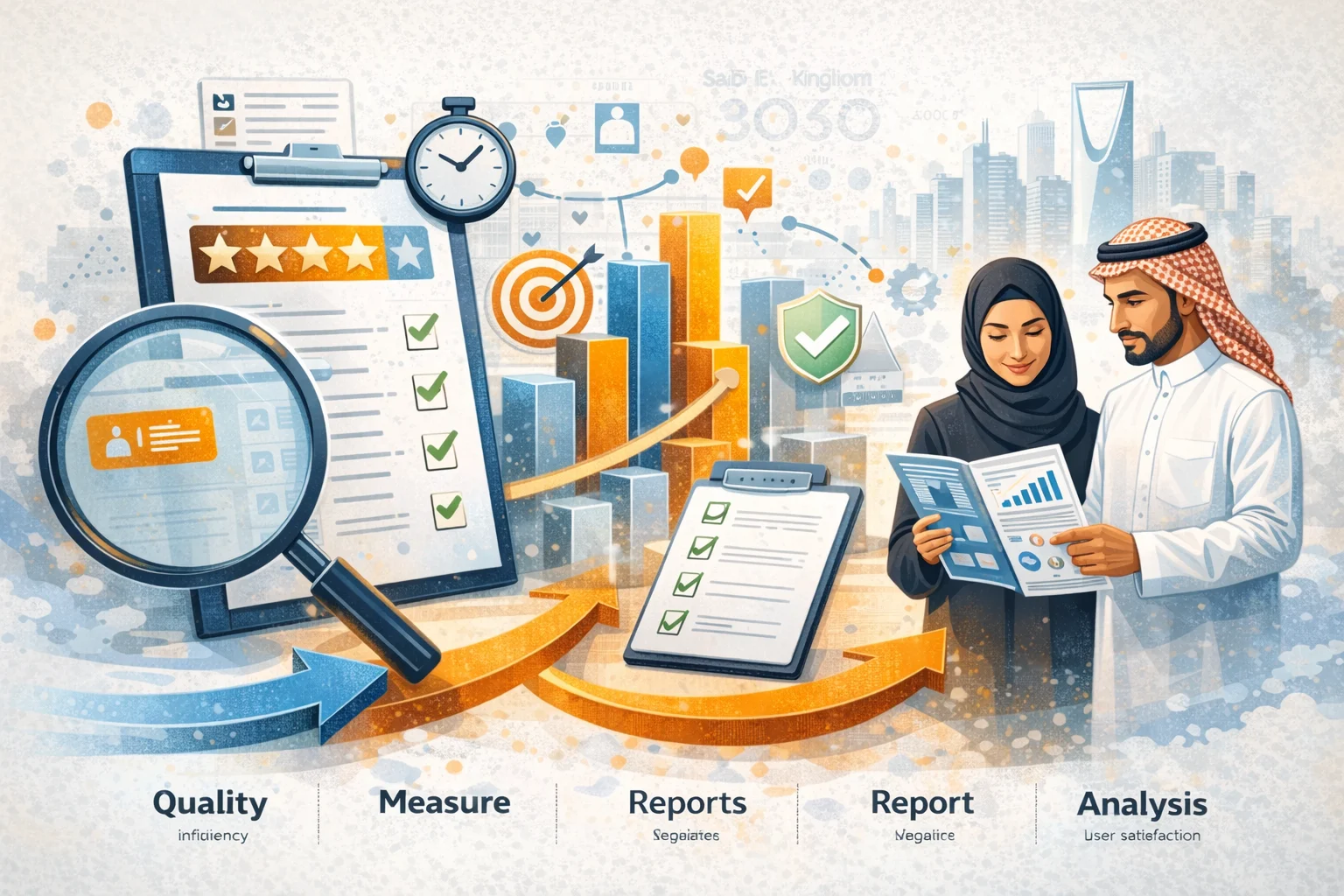
Service quality evaluation is today one of the most important tools of governance and development in Saudi entities. With rising beneficiary expectations and the drive for continuous improvement, quality evaluation has become a strategic necessity for ensuring service efficiency and achieving organisational excellence. In this article, we review a practical approach to applying service quality evaluation in line with the requirements of the Saudi market and the professional identity of RateHex.
Service Quality Evaluation Through Precise Service Quality Measurement
Measurement as the Basis of Evaluation
Service quality evaluation starts from systematic, precise service quality measurement. Measurement provides a realistic picture of the current service level and reveals the gaps between actual performance and target standards. Without clear measurement, evaluation becomes an estimate that cannot be built upon.
Measurement tools include service time indicators, the rate of adherence to standards, the error rate and the level of beneficiary satisfaction. This data is the primary input to any development decision.
Building an Effective Measurement System
It is important that measurement indicators are defined, comparable and linked to strategic goals. When the measurement system is managed professionally, service quality evaluation becomes an effective tool for guidance.
Saudi Example
In a government service entity in Saudi Arabia, a unified model for measuring service quality was applied across branches. This helped reveal differences in performance and improve fairness in the level of service.
Summary
Service quality evaluation rests on precise service quality measurement, where reliable data is the basis for any real and sustainable improvement.
Service Quality Evaluation as a Gateway to Improving Service Quality
From Evaluation to Improvement
Service quality evaluation aims not only at monitoring but at supporting service quality improvement in a practical way. Evaluation reveals weaknesses and strengths, while improvement translates the results into tangible development initiatives.
When evaluation results are linked to clear improvement plans, quality becomes a continuous process and not a temporary initiative.
Managing Continuous Improvement
Continuous improvement requires clear priorities, the allocation of responsibilities and a timetable for implementation. This is where the role of leadership appears, in supporting a culture of quality and strengthening commitment.
Saudi Example
In the health services sector in Saudi Arabia, a medical facility adopted the results of quality evaluation to develop its reception procedures. This reduced waiting times and improved patient satisfaction.
Summary
Service quality evaluation contributes to directing the efforts of service quality improvement and ensures that development initiatives are built on actual conditions.
Service Quality Evaluation Through Professional Service Quality Reports
The Importance of Reports in Decision-Making
Service quality reports are the executive output of the evaluation process. Clear reports enable leaders to understand performance quickly and make decisions based on accurate data.
A good report does not stop at numbers; it shows trends, explains results and suggests opportunities for improvement.
Characteristics of an Effective Report
Among the most important characteristics of effective reports are clarity, brevity, comparison over time and linking results to strategic goals. In this way, service quality evaluation becomes an organisational communication tool.
Saudi Example
A regulatory authority in Saudi Arabia developed monthly quality reports to present the performance of service providers. This helped raise the level of compliance and improve transparency.
Summary
Service quality reports are a central element in the success of service quality evaluation, as they move results from the level of analysis to the level of decision.
Service Quality Evaluation Based on Service Quality Standards
Standards as a Fair Reference
The effectiveness of service quality evaluation depends on the clarity of service quality standards. Standards are the reference on the basis of which measurement and evaluation are carried out, and they ensure fairness and objectivity.
Standards include aspects such as service time, accuracy of delivery, ease of access and clarity of procedures. The clearer the standards, the more credible the evaluation.
Aligning Standards with the Saudi Context
It is essential that standards are consistent with local regulations and with beneficiaries’ expectations in Saudi Arabia, to ensure that the evaluation is realistic and applicable.
Saudi Example
In the education sector, a Saudi university adopted clear quality standards for academic and administrative services. This helped unify evaluation and improve the level of service provided to students.
Summary
Service quality standards form the basis on which service quality evaluation is built in a fair, objective and comparable way.
Service Quality Evaluation and Its Role in Evaluating Organisational Performance
Quality as One Dimension of Performance
Evaluating organisational performance is today closely tied to service quality. Organisational performance is not measured by outputs alone, but by the quality of what is delivered to beneficiaries.
When quality evaluation results are integrated into the performance evaluation system, a comprehensive and balanced view of organisational performance is achieved.
Supporting Governance and Transparency
Quality evaluation contributes to strengthening governance, improving accountability and raising the level of transparency towards stakeholders.
Saudi Example
In a major service organisation in Saudi Arabia, the results of service quality evaluation were included in the annual performance reports. This improved the evaluation of organisational performance and strengthened stakeholder confidence.
Summary
Service quality evaluation supports the process of evaluating organisational performance by linking quality to performance, governance and strategic results.
Frequently Asked Questions About Service Quality Evaluation
-
What is meant by service quality evaluation?
A systematic process of measuring and analysing the quality level of the services provided. -
What is the difference between measurement and evaluation?
Measurement is collecting data; evaluation is analysing it and making decisions based on it. -
How does evaluation contribute to improving quality?
By identifying gaps and directing improvement initiatives. -
What is the role of service quality reports?
Summarising results and supporting management decision-making. -
Are standards necessary for quality evaluation?
Yes, to ensure objectivity and fairness in the evaluation. -
How does evaluation serve organisational performance?
It links service quality to overall organisational performance. -
Is quality evaluation suitable for government entities?
Very much so, especially for improving beneficiary satisfaction. -
How often should evaluation be carried out?
Periodically, depending on the nature of the service. -
What are the most prominent service quality indicators?
Completion time, accuracy, adherence and beneficiary satisfaction. -
How does an entity begin evaluating the quality of its services?
By defining standards, measuring, and then preparing reports.
Service quality evaluation is the cornerstone of any successful organisational development journey. Through precise measurement, continuous improvement, professional reports and clear standards, quality becomes a strategic tool that strengthens organisational performance in the Saudi market. At RateHex, we help you build an integrated evaluation system that turns data into decisions and quality into sustainable value. Start today with a confident step towards more efficient and more impactful services.




